



Release Notes
Ibexa DXP v5.0.10 LTS Update: Translate automatically, review side-by-side
4 min - 21 August 2026
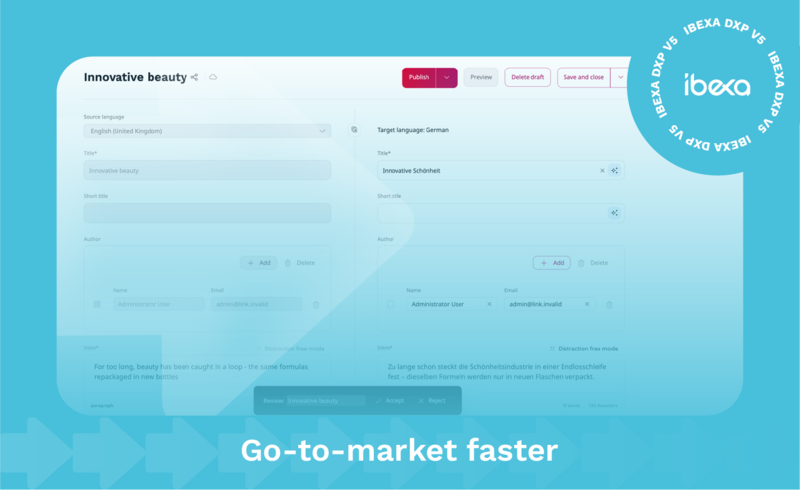
Ibexa DXP LTS Update 5.0.10 introduced the new Translation Management feature to Headless, Experience and Commerce editions. Content teams can now translate, review, and publish multilingual content without leaving the editorial interface, cutting out the manual handoffs and vendor-juggling that usually slow multi-market rollouts down. It's a small change to the workflow with a big effect on how fast you can move into new markets.
Go global faster with less room for error
Expanding into new markets has always come with an extra tax: the time and effort of localising your digital content. With the release of Translations Management, that tax just got smaller.
This new LTS Update brings automated translation and side-by-side editing layout into the platform you use every day. Workflows become faster, less error-prone, and easier to scale; freeing content teams from manual handoffs and copy-and-paste repetition.
If you’re a business leader weighing how fast (and how affordably) your organisation can scale into new markets, this release is worth your attention.
Translate on your terms with a flexible translation engine
At the heart of this update is a flexible translation engine that connects Ibexa DXP directly to the translation providers your business already trusts, or wants to try.
Instead of locking you into a single vendor, Ibexa DXP allows you to assign a different provider per language pair; for example, using DeepL for English-to-French content, while routing Polish-to-English translations through Google Translate.
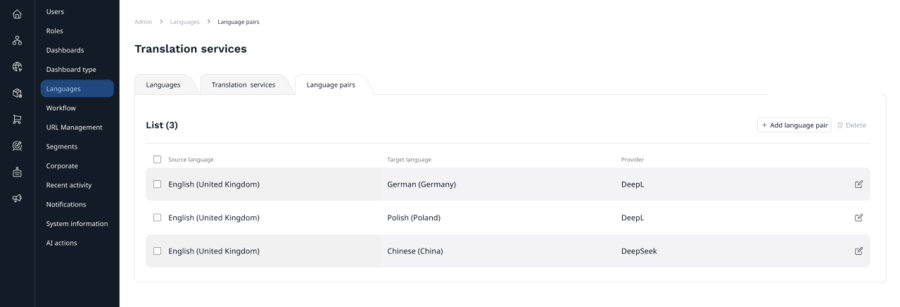
Out-of-the-box, the Translation management package can be configured to support the following machine translation providers:
- Google Translate
- DeepL
- OpenAI
- Anthropic Claude
- Google Gemini
Ibexa DXP stores and encrypts all credentials securely. Content is only sent to the translation provider at the moment a translation is requested, with the results returned directly into the editorial interface.
Business Impact: Marketing and Content Teams can choose the highest performing or most cost-effective engine for each market, rather than compromising on a single default. Multilingual content can roll out in days instead of weeks; significantly cutting time-to-market.
Simplify the translation process with side-by-side editing
Localisation quality is notoriously hard to manage, especially on large, multi-market sites. When awkward phrasing, spelling errors and missing sections slip through they can undermine brand trust.
The new side-by-side translation view solves this by placing source and target content on the same screen. Editors and translators can:
- Compare source and target text line by line for full contextual alignment
- Fix issues on the spot in a distraction-free editing mode
- Accept or reject automatically translated drafts, marked “For review”
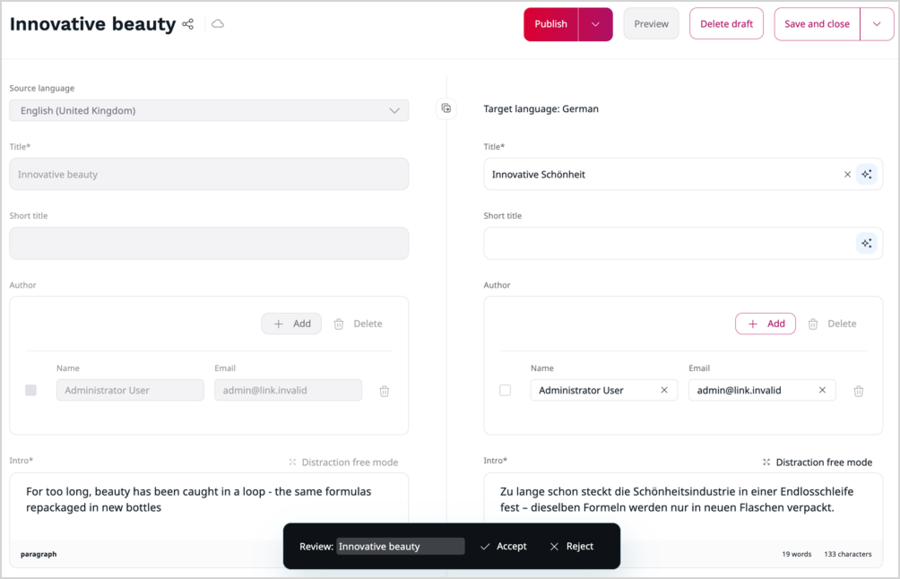
Source content stays locked in this view, protecting the integrity of your original copy while still giving editors full control over the translated version. (Note: this view isn't yet available for Page Builder content: that's on the roadmap.)
Business Impact: Higher-quality localised content means fewer customer-facing errors, stronger brand consistency across markets, and less time spent on review cycles or damage control.
Developer experience
Translations Management isn’t just about the editing experience - it’s also designed for teams managing translation at volume.
A new console command lets developers and DevOps teams trigger translation of a single item from the command line, enabling batch processing and automated workflows.
Developers can also extend the translations management package to create custom translation providers and content type exclusion rules.
Why offer both? Dedicated translation providers vs. AI language models
A natural question for technical and business leaders alike: with LLMs getting so good at translation, why does Ibexa DXP support traditional machine translation providers like DeepL and Google Translate at all? The answer is that the two approaches solve different problems, and the strongest localisation strategies use both.
Dedicated translation providers are purpose-built for high-volume, cost-efficient throughput, and provide a critical advantage when translating large product catalogs, UI strings, or support content at scale. They're also deterministic, producing the same translation for the same input every time, which matters for legal text, interface labels, and anything requiring strict consistency across a site. Mature glossary and terminology-management tools further ensure regulated industries and technical documentation stay on-brand and compliant, while broad language-pair coverage, including many low-resource languages, makes them the safer default for global reach.
AI language models, by contrast, tend to shine where nuance matters: marketing copy, brand voice, idioms, and culturally aware adaptation, often in the same step as summarising or reformatting content. By giving teams the flexibility to assign REST API-based providers or AI-based on a per-language, per-content basis, Translations Management lets organisations build exactly this kind of hybrid workflow.
Business Impact: Rather than forcing a one-size-fits-all translation strategy, this flexibility lets teams optimise for cost and consistency.
Why this matters for your roadmap
Multilingual, multi-market delivery has always been a strategic differentiator, but it's often been slowed down by fragmented tools and manual processes. With native Translations Management, Ibexa DXP turns localisation from a bottleneck into a repeatable, governed, and largely automated part of your content operation.
Whether you're entering a new region, consolidating multiple translation vendors into one workflow, or simply trying to get content live faster without sacrificing quality, this release gives your team the tools to do it.
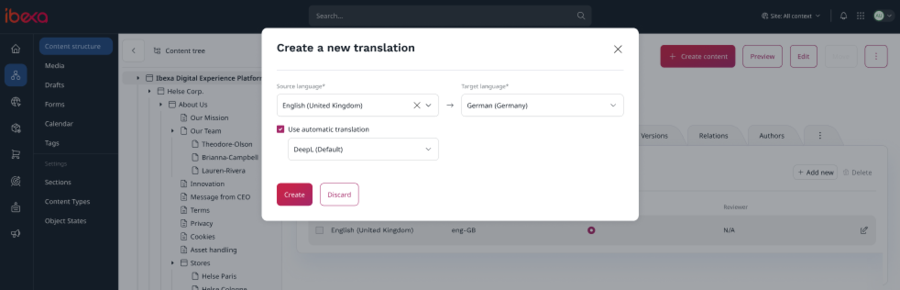
Ready to scale into new markets?
Ibexa DXP v5.0.10 is available to install and configure now, for all customers across Headless, Experience, and Commerce editions. Talk to your Ibexa partner or account team about configuring Translations Management for your content model, or upgrading to v5.0 LTS.
Full details: Ibexa DXP v5.0 Release Notes
New to Cohesivo? Request a demo to see these capabilities in action