



Content Strategy
Content workflow: how to design a process that scales
5 min - 17 November 2026
A content workflow is the sequence of steps, roles and approvals that takes content from first draft to publication.
Designing one means deciding who does what and what stays under human control. The process also has to stay readable as teams, markets and sites multiply. This guide from Cohesivo, the Agentic CMS, covers the stages, the roles, publishing across markets and the place of automation.
What is a content workflow?
A content workflow defines the path content takes through your organisation: the stages it passes through, the person responsible at each stage and what must be in place before it moves on. A blog article, a campaign landing page and a product sheet can follow different workflows, because their risks and audiences differ.
A workflow is distinct from three neighbouring ideas. Project management tracks tasks and deadlines. Content governance sets the rules, standards and permissions that workflows apply. The content lifecycle covers what happens after publication: updates, reuse, retirement. This article focuses on the workflow itself, from draft to publication.
Content production workflow: the key stages
The names vary from one organisation to the next, but most content production workflows rest on the same stages:
- Plan: agree the objective, audience, owner and deadline before anyone starts writing.
- Create: write and edit, ideally in the tool that will publish the content, to avoid copying and pasting between tools.
- Review: check accuracy, brand tone and compliance. Several reviewers can work in parallel when the content touches several areas.
- Approve: name one accountable person who gives the go-ahead. The system records who approved what.
- Publish: put the content live on the right site, in the right market and on the right channel when it is ready.
- Update: define what triggers a revision, so published content does not go stale.
Not every piece of content goes through every stage. For example:
- Blog article: plan, create, review, approve, publish, with a single editorial owner who approves.
- Campaign landing page: add a brand and legal review, approved by marketing leadership.
- Pricing or legal page: add product and legal checks, with two named approvers.
How to design a content workflow that scales
A workflow has to stay clear however many people or pieces of content pass through it. Adding steps rarely helps.
- Map what exists: follow a few real pieces of content from idea to publication and note every handover, every tool and every delay.
- Define the stages and their exit criteria: each stage needs a clear condition for moving on, such as “fact review complete” or “legal approval obtained”.
- Assign the work to roles: define writers, reviewers, approvers and publishers as roles, so the workflow survives departures and holidays.
- Match approval to risk: keep heavy approvals for sensitive content and keep routine content light.
- Plan one workflow per content type: when each content type has defined fields, as with structured content in a headless CMS, you can attach a different workflow to each type.
- Document and review: treat the workflow as a living process. Find where content waits longest and adjust.
Two pitfalls come up often. A single approver becomes a bottleneck as volume grows. And a workflow built for one site often seizes up when a second market arrives.
Signs that a workflow needs a rethink:
- content waits for approval and nobody owns the delay;
- the same draft is reviewed by more people than necessary;
- teams or markets work around the process;
- nobody can say who approved a published page.
Editorial workflow: roles, approvals and handovers
An editorial workflow makes handovers explicit. For each transition, for example a draft going from writer to reviewer, you want to know who receives it, what is expected of them and what comes next.
When you evaluate a CMS, look for:
- Choice of reviewer at handover: the right person is asked, and the draft does not sit in an anonymous queue.
- Permissions by stage and by transition: only the right roles can move content forward.
- Draft locking: two writers do not edit the same draft during review.
- A visible history of transitions: who moved a piece of content forward, and when.
- Version control: the reviewer sees what has changed.
These capabilities matter more as teams grow. Without them, review happens by email and chat, and the record of who approved what sits outside the system.
Content publishing workflow across markets and sites
On a multi-market project, a workflow built for a single site rarely covers what each market needs. The same content may need a translation, a local adaptation and a different approver in each market.
Decide early what is centralised, what markets reuse from one another and what stays local. A central team can own product messaging and the brand, while local teams handle examples, offers and legal wording.
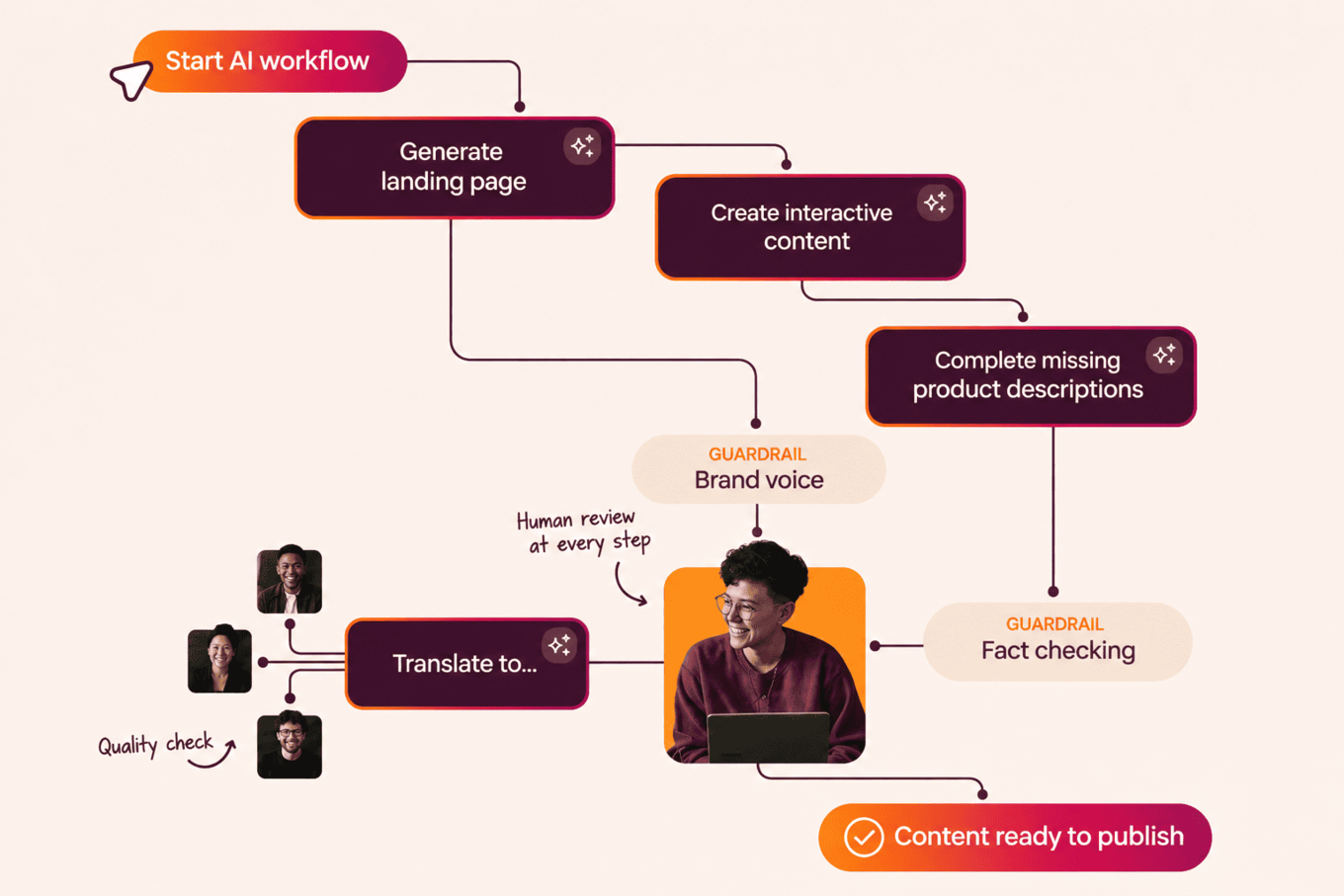
Make translation a stage of the workflow, with its own owner and a level of review that matches the risk. AI-assisted translation can provide a first version quickly. For routine content, a quick sanity check may be enough; regulated, strategic or product-sensitive content should receive local human approval before publication. Publishing then becomes a decision per market: some content goes live everywhere at once, other content follows a local schedule.
The risk to watch is fragmentation. If every market designs its own workflow, the organisation ends up with as many processes as sites. Managing all your sites, brands and languages from one environment for multisite and multilingual content management makes it easier to share stages and roles while keeping each market’s specifics.
Content workflow automation: what to automate and what stays human
Once stages and roles are clear, automate the repetitive tasks:
- routing content to the next reviewer and sending reminders;
- checks that need no judgement, such as missing metadata, broken links or formatting;
- a first review against brand and compliance rules;
- a first translation that a person refines.
Keep risky decisions in human hands: approving strategic pages, confirming product messages and handling anything legal or sensitive. A useful rule: automation prepares the work, a person decides.
AI agents fit this model well. They can take on the first passes above, provided they work with the same permissions and approvals as a colleague.
How Cohesivo supports content workflows
Cohesivo is the Agentic CMS: a content platform that keeps your team in one place, from first draft to publication, in four stages: collaborate, check, approve and publish. A clear history shows who did what at approval. The content creation page details each stage.
In practice:
- Cohesivo ships with a preconfigured Quick Review workflow, and workflows respect permissions: access is limited by stage and by transition, on the administration side.
- You choose a reviewer at each transition, you can lock a draft for the writer who sent it for review, and a timeline shows the workflow transitions.
- Custom workflows, version control and role-based permissions support marketing teams, writers and approvers.
- AI-assisted translation is built into the workflow, for all your sites, brands and languages.
Cohesivo Agents, powered by the Ibexa Agentic Platform, are presented as available on the current public Cohesivo site. They give drafts a first pass before a human reviewer sees them, and a person’s permissions apply to everything an agent does on their behalf.
See how Cohesivo manages content, from first draft to publication.