



Content Strategy
Content lifecycle management: keep content accurate and reusable
5 min - 23 November 2026
Content lifecycle management is the practice of managing content through its whole life, from creation to retirement, with the most attention on what happens after publication.
This guide from Cohesivo, the Agentic CMS, explains the stages of the content lifecycle, how to set up a content review process and how to decide what to update, reuse, archive or remove.
Many teams have a defined publishing process. What is often less structured is what happens next: who checks a page again, when it is updated, when it is reused and when it is retired. Without that structure, content libraries fill up with pages that are out of date, duplicated or forgotten.
What is content lifecycle management?
Content lifecycle management (CLM) is the process of overseeing content from creation through publication, maintenance and eventual retirement. It treats each piece of content as something with an owner, a status and a history, so decisions about it are made on purpose. This is the life of the content itself. It differs from the buyer journey, from awareness to loyalty, which describes your audience and not your content.
The scope is time. Two neighbouring topics cover other ground. A content workflow from creation to publication describes how content goes live. Content governance sets the rules, roles and standards that apply along the way. Lifecycle management looks after content for as long as it stays live.
What are the stages of the content lifecycle?
The names vary, but most content lifecycle processes pass through the same six stages:
- Plan: decide what the content is for, who it serves and who owns it.
- Create: draft, edit and approve the content.
- Publish: put it live on the right site, in the right market and on the right channel.
- Maintain: check accuracy and relevance on a schedule and whenever something changes.
- Reuse or update: refresh what still matters and reuse what works elsewhere.
- Archive or remove: take content out of circulation once it no longer serves a purpose.
A content workflow focuses mainly on the path to publication. Lifecycle management extends that view into maintenance, reuse, updating and retirement.
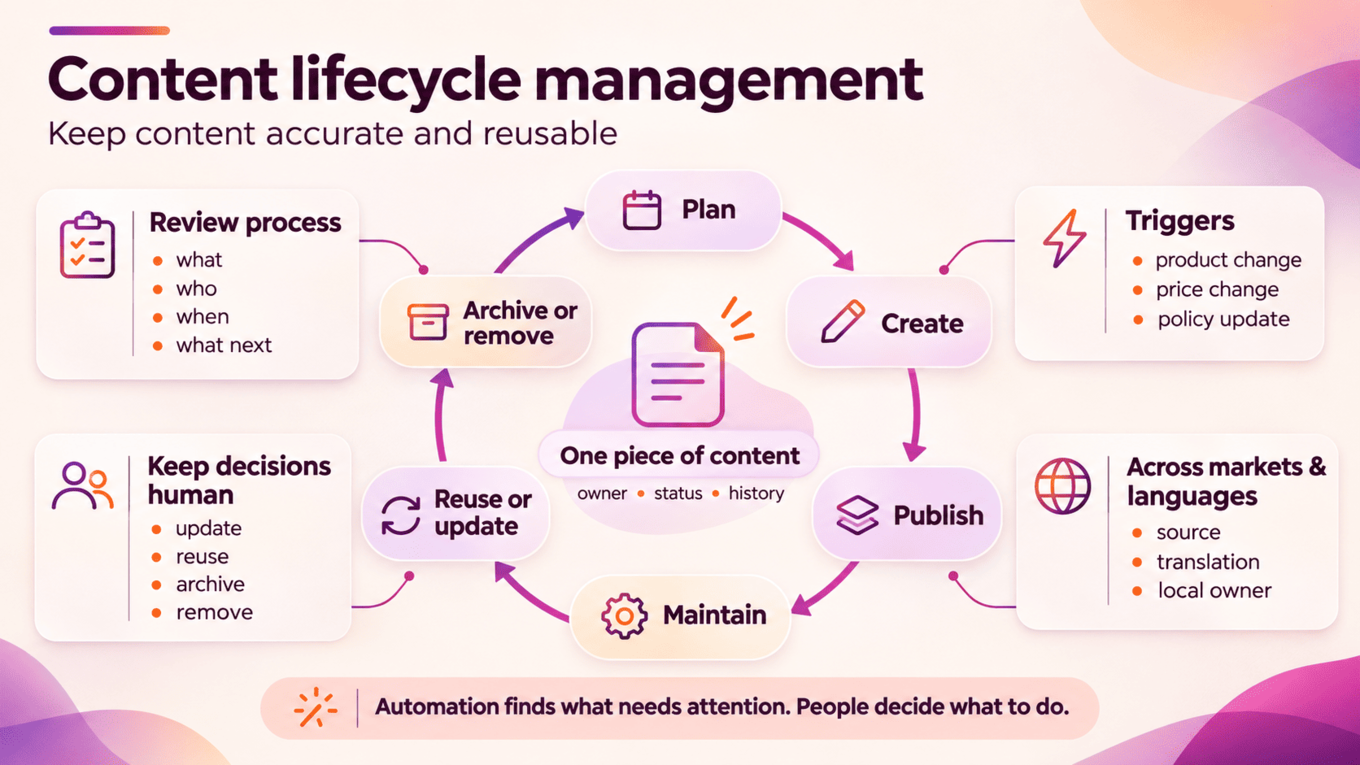
A content lifecycle strategy ties these stages to your priorities. Decide which content types matter most, how long each stays useful and who is accountable at each stage. A pricing page and an evergreen guide need very different lifecycles.
Why content becomes outdated
Content ages for ordinary reasons. Products change, prices move, regulations are updated, teams reorganise and campaigns end. Nothing flags the page, so it stays live.
The cost is quiet: visitors lose trust, search engines and AI answer engines find conflicting information and teams spend time rewriting what already exists.
Content maintenance often fails for three reasons:
- No owner: nobody is accountable for keeping the page accurate.
- No trigger: nothing prompts a review when a product, price or policy changes.
- No visibility: teams cannot see which content is old, duplicated or unused.
Signs that a content lifecycle is badly managed:
- pages nobody can attribute to an owner;
- product claims that contradict each other across pages or markets;
- campaign pages still live after the campaign;
- pages for products or services you no longer sell;
- team pages that still list people who have left;
- several versions of the same content;
- translated pages that no longer match their source;
- editors creating new content because they cannot find the existing one.
How to build a content review process
A content review process answers four questions: what is reviewed, by whom, how often and what happens next.
- Classify your content: group it by risk and by how fast it ages. Product pages, pricing and legal content age faster than evergreen articles.
- Name an owner for each group: an owner is accountable for accuracy, whether or not they write the content.
- Set review intervals and triggers: use a schedule for routine checks (for example, a yearly review of evergreen articles) and triggers for the rest, such as a product release, a price change or a regulatory update.
- Define the outcomes: every review ends in one decision: keep, update, reuse, archive or remove.
- Record the result: log who reviewed what and when, so the next review starts from facts.
Roles keep the process moving. A typical split:
- Owner: accountable for accuracy and for the decision to keep, update, reuse, archive or remove.
- Reviewer: checks the content against the facts, the brand and any compliance rules.
- Approver: signs off high-risk changes, such as product claims or legal wording.
- Publisher: applies the change on the right site, in the right market and on the right channel.
- Keep the process light. A short review for low-risk content and a fuller one for sensitive content is easier to sustain than one heavy process for everything.
When to update, reuse, archive or remove content
Each review ends in one of four decisions. The right one depends on whether the content still serves a purpose and whether it is still accurate.
When to update
The topic still matters but the details have changed. Revise the content and keep the URL.
Content reuse
The content works and suits another market, channel or format. Adapt it instead of writing it again. Reuse works best when content is modelled in reusable parts. With content models in a headless CMS, the same item can feed several pages and channels. Reuse is not duplication. Copying and pasting creates two versions to maintain. Where the same structured content item is reused, one update can be reflected wherever that item appears.
Content archiving
The content has no current use but may serve as a reference or meet a compliance obligation. Take it out of active navigation and, where appropriate, search and indexation.
When to remove content
The content is wrong, duplicated or has no value. Delete it and redirect the URL when there is a relevant replacement. Otherwise, let the appropriate 404 or 410 response apply.
Content lifecycle management across markets and languages
Several markets and languages multiply the lifecycle. One product change can affect many pages, in several languages, owned by different teams. A translated page that no longer matches its source is outdated, even if nobody has touched it.
Decide early who triggers updates, who adapts them locally and how translated pages are flagged when the source changes. Managing every site, brand and language from one environment, with centralised multisite and multi-brand management, makes that coordination easier.
Three questions help: who owns the global source, who owns each local version and what happens to a translation when its source is archived?
What to automate in the content lifecycle
Automation helps most where the work is repetitive and the judgement is light:
- flagging content that has passed its review date;
- triggering a review when a product, price or policy changes;
- spotting duplicated or inconsistent content;
- flagging translations that fall out of sync with their source;
- keeping taxonomy and tagging consistent.
Start with the checks that cost the most manual time and carry the least risk, then widen the scope.
Keep decisions in human hands: whether a page is updated, archived or removed, and whether a product claim is still true. A useful rule: automation finds the content that needs attention, a person decides what to do with it.
How Cohesivo supports content lifecycle managementCohesivo provides platform controls that support a content lifecycle: custom workflows, version control and role-based permissions for editors and approvers. You can manage content across sites, brands and languages from one environment, with AI-assisted translation built into the workflow. Cohesivo Agents, powered by the Ibexa Agentic Platform, can help with the maintenance work: flagging outdated pages, keeping taxonomy consistent and flagging translations that fall out of sync when the source changes. Cohesivo Agents run inside the platform and work alongside content teams on defined tasks, while people retain control over approval and publishing. Your team keeps control of every decision to update, archive or remove. The lifecycle rules themselves still have to come from your organisation: who owns each type of content, how often it is reviewed and what triggers a change. |