



Content Strategy
Content governance: a practical framework
6 min - 24 November 2026

Content governance defines responsibility for content, the application of rules, how decisions are made and what happens to content after publication.
How to keep content accurate and consistent without slowing teams down? Without governance, content operations tend to rely on individual habits. One team updates a product page. Another publishes a different version of the same message. Nobody is sure who owns approval, when an outdated page should be reviewed or which source is authoritative. The organisation adds sites, markets, languages, contributors and AI tools… Things get more complicated.
What is content governance?
Content governance is the system of roles, rules, standards and processes used to control how content is created, reviewed, approved, published, maintained and retired.
It answers questions such as:
- Who owns this content?
- Who can create, edit and approve it?
- Which standards must it meet?
- Which information is authoritative?
- When should it be reviewed?
- Who decides whether it is updated, reused, archived or removed?
- What happens when teams disagree?
Content management governance versus content management
The two are related, and they are different things. Content management is the operational process of creating, storing, publishing and delivering content. Content management governance, which is content governance applied to that process, defines the decision rights and associated controls.
Content management helps teams work with content. Content governance determines how that work is controlled.
Why content governance matters
Content problems rarely start with one major failure. They accumulate. A product claim becomes outdated. A page has no clear owner. Two countries translate the same content differently. A campaign page stays live after the campaign ends. A new editor creates another version because they cannot find the existing one.
The more content an organisation manages, the more these small inconsistencies compound. Governance reduces that drift by making ownership and decision-making explicit.
It matters most when organisations manage:
- several websites or brands;
- multiple markets and languages;
- distributed marketing and content teams;
- regulated or approval-heavy content;
- reusable content across channels;
- frequent product updates;
- AI-assisted content production.
Governance does not mean adding an approval step to everything. Good governance makes routine decisions easier and reserves stronger controls for content that carries greater risk.
The core elements of a content governance framework
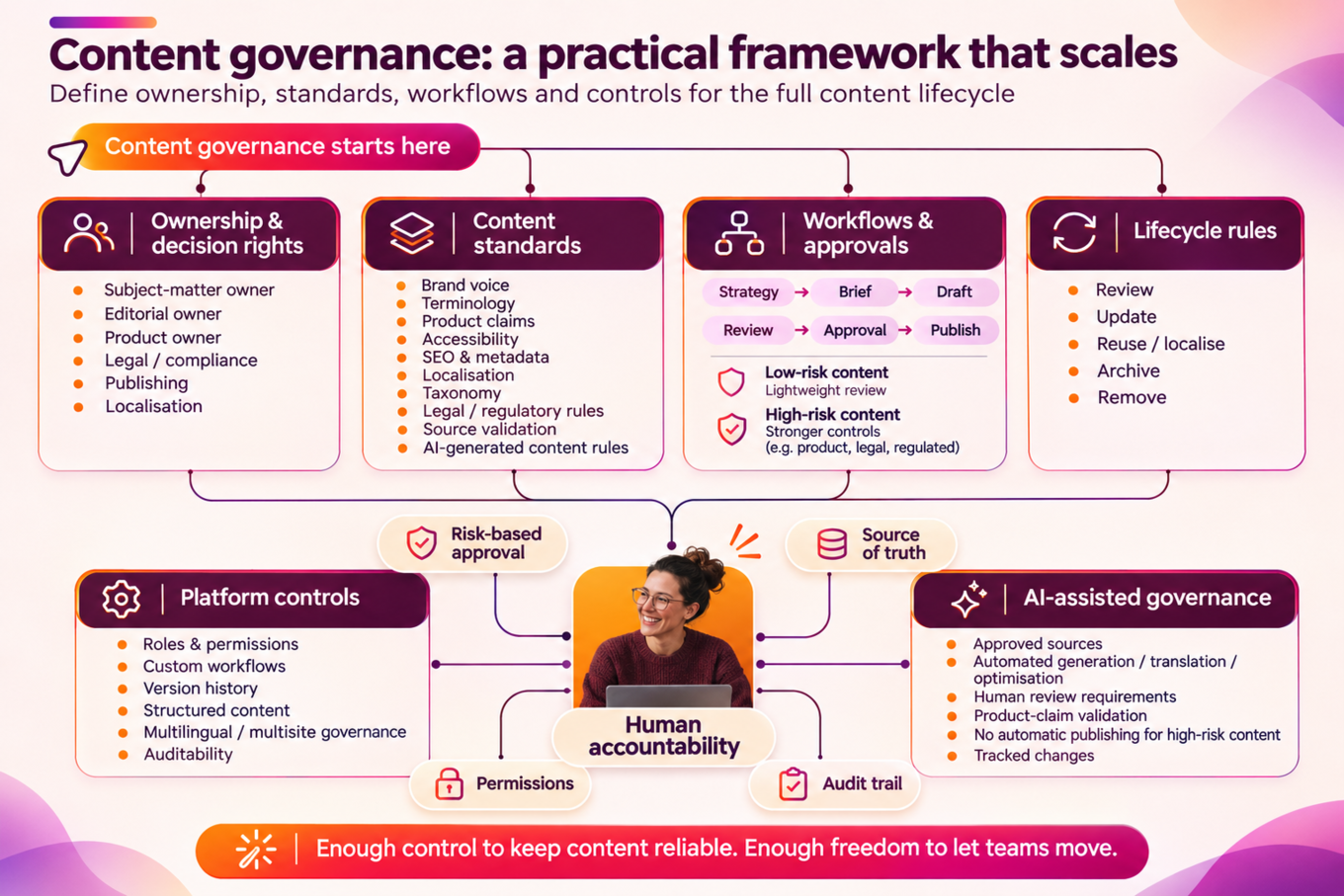
A useful framework usually has five connected elements.
1. Ownership and decision rights
Every important content area should have a clear owner. Ownership means being accountable for the content’s accuracy, relevance and lifecycle, whether or not the owner writes it.
You may need to distinguish between:
- subject-matter ownership;
- editorial ownership;
- product ownership;
- legal or compliance approval;
- publishing responsibility;
- localisation responsibility.
The objective is to know who has the authority to decide (without involving everyone in every decision). A simple test helps: if nobody can say who owns a page, topic or content type, governance is already weak.
2. Content standards
Teams need shared rules for what acceptable content looks like. These may cover:
- brand and tone of voice;
- terminology;
- product claims;
- accessibility;
- SEO and metadata;
- localisation;
- taxonomy;
- legal or regulatory requirements;
- source validation;
- use of AI-generated content.
Some standards belong in guidelines. Others should be built into templates, workflows or CMS permissions, so teams do not have to remember them every time. The more repeatable a rule is, the stronger the case for building it into the way you work.
3. Workflows and approvals
Governance defines how content moves from idea to publication. A workflow may include:
Strategy → Brief → Draft → Review → Approval → Publish
Not every content type needs the same workflow. A low-risk blog update may need one quick review. A homepage claim, a sales deck or a regulated statement may require product or legal validation. Our guide to designing a content workflow covers the stages and roles in detail.
The important point is to make these differences intentional. Good governance defines:
- who enters each stage;
- who can approve;
- what must be checked;
- when escalation is required;
- what can be published without additional review.
Fewer unnecessary approvals, with controls kept where they matter.
4. Lifecycle rules
Publishing is not the end of content management. Governance also defines what happens afterwards. For important content, teams should know:
- who owns ongoing accuracy;
- when the content is reviewed;
- which events trigger an update;
- whether it can be reused or localised;
- when it should be archived;
- when it should be removed.
This matters most for product pages, documentation, evergreen articles and multilingual content. Without lifecycle rules, content libraries grow faster than teams can maintain them.
5. Platform controls
Governance becomes more reliable when the CMS supports the operating model. Useful capabilities include:
- roles and permissions;
- custom approval workflows;
- version history;
- content ownership;
- structured content;
- multilingual workflows;
- multisite governance;
- auditability;
- scheduled or lifecycle-based review;
- reusable content models.
Content models help too: structured content in a headless CMS makes ownership and reuse easier to apply. The platform should support the governance model and leave its design to you. Choosing a CMS with permissions does not, by itself, create governance.
Centralised, decentralised or hybrid governance?
No single governance model works for every organisation. A centralised model gives one team strong control over standards and publishing. This can improve consistency but may slow local teams. A decentralised model gives individual markets, brands or business units more autonomy. It increases speed but can create duplication or inconsistent standards. Many organisations use a hybrid model. For example:
- central teams define brand, platform and governance standards;
- local teams adapt and publish market-specific content;
- product teams own product truth;
- content teams own editorial expression;
- higher-risk claims require specialist approval;
- routine content follows lighter workflows.
The right model depends on organisational structure, risk and content complexity.
How to build a practical content governance framework
Start with the current operating model, not the ideal one. Map how content is actually created today. Identify:
- who creates content;
- who reviews it;
- who approves it;
- which tools are used;
- where information comes from;
- where delays occur;
- which decisions are repeated;
- which content has no clear owner.
Then standardise the parts that create recurring friction. Define a small set of roles, rules and workflows before trying to govern every possible content scenario. A useful first version might include:
- Ownership: who is accountable for each major content type or topic.
- Standards: the minimum requirements before publication.
- Workflow: the review and approval path for each content risk level.
- Lifecycle: review and retirement rules.
- Escalation: who decides when the normal process is not enough.
Test the framework in real workflows before adjusting it to the needs teams define.
What changes when AI enters the content workflow?
AI increases the need for governance. When AI can generate, translate, optimise or update content quickly, organisations need clear rules for what the system is allowed to do and where humans remain accountable. Questions include:
- Which sources can AI use?
- Which content can be generated automatically?
- Which outputs require human review?
- Who validates product claims?
- Can AI publish directly?
- How are translations checked?
- Who is responsible when an automated update is wrong?
- How are changes tracked?
The objective is to set different levels of control based on risk, so that nobody has to review every AI output manually. Routine metadata, tagging or low-risk translation may need only a quick sanity check. Strategic pages, product claims or regulated content may require specialist review. Governance makes that distinction explicit.
Common content governance mistakes
A governance model fails if it becomes too weak or too heavy. Common problems include:
- no clear content ownership;
- approval by too many people;
- rules documented but not enforced;
- one workflow for every content type;
- no lifecycle management after publication;
- local teams unable to adapt centrally created content;
- product information copied into multiple uncontrolled sources;
- AI introduced without clear review or accountability rules.
The goal is enough control to make content reliable while letting teams work efficiently.
How Cohesivo supports content governanceCohesivo provides platform controls that support a content governance model: custom workflows, version control and role-based permissions for editors and approvers. You can manage content across sites, brands and languages from one environment, with multisite governance applied to every market. The platform’s content governance controls sit alongside them. Cohesivo Agents, powered by the Ibexa Agentic Platform, can assist with operational governance tasks: giving drafts a first pass against brand and compliance rules, keeping taxonomy consistent and flagging outdated content. Cohesivo Agents run inside the platform and work alongside content teams on defined tasks, while people retain control over approval and publishing. Teams keep control of publishing decisions. The governance model itself still has to come from the organisation: who owns content, which standards apply and where human validation is required. |