



Content Strategy
CMS translation: how to manage multilingual content at scale
4 min - 18 November 2026
CMS translation is the set of workflows, content relationships and controls used to create and maintain multilingual versions of content inside a content management system.
Translation becomes difficult when source content changes often, markets publish independently or teams copy pages between systems. The goal is to keep source and local versions connected, visible and maintainable.
What is CMS translation?
CMS translation covers how a CMS handles each language version: creating variants, sending content for translation, tracking status, reviewing, publishing by market and maintaining links between source and translated content.
The relationship between versions matters. A linked translation can be tracked and updated when the source changes; an isolated copy cannot.
Translation vs localisation vs multilingual content management
- Translation: converting content from one language to another.
- Localisation: adapting content for a specific market, including terminology, examples, legal requirements, formats and cultural context.
- Multilingual content management: the system and workflow used to manage every language version over time.
Why does CMS translation become difficult at scale?
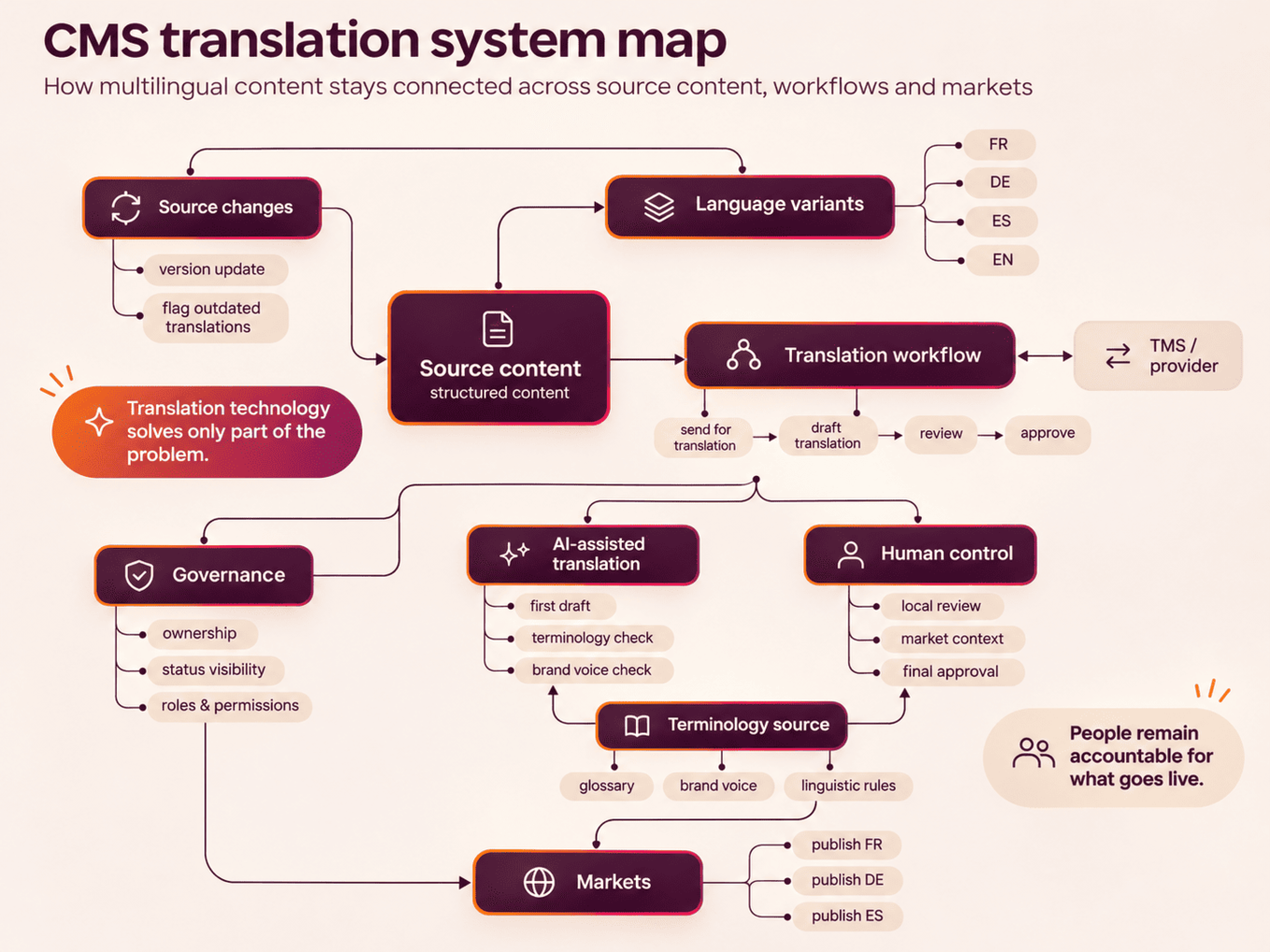
The first difficulty is keeping versions in step. Source changes can make translations stale, copied pages drift away from the source, and reusable content fragments can appear in many places and languages at once, so a single edit may need to reach several versions.
The second is coordination. Several translators, agencies and markets need to work together, terminology must stay consistent, and approval requirements can differ by market, with some markets needing local control over timing and messaging. Throughout, teams need visibility into what is translated, outdated or waiting for review.
At scale, coordination usually becomes the bigger problem than the act of translation itself.
How does a CMS translation workflow work?
- Create or update source content.
- Select required languages.
- Send content for translation or generate a first draft.
- Translate or adapt the content.
- Return or save the translation in the CMS.
- Run local review for terminology, meaning and market context.
- Approve the version.
- Publish each market when ready.
- When the source changes later, flag the affected versions for review.
The last step is critical: source changes need to remain visible across every language version.
Common CMS translation models
- Manual translation inside the CMS: Editors or translators work directly in language variants. This can suit lower volumes.
- Export and import: Content moves to an external provider and returns to the CMS. It adds hand-offs and version-control risk.
- TMS integration: The CMS exchanges content with a translation management system. This supports larger programmes and linguistic assets.
- AI-assisted translation: AI produces a first version and supports checks. Human review remains appropriate where brand, legal, specialist or market context matters.
What should stay under human control?
Human judgement matters most where meaning and risk are hardest to automate: brand voice and nuance, legal or regulated claims, specialist terminology and culturally sensitive content. Market-specific messaging and offers also need a local owner, and final publication approval should stay with a person wherever the organisation requires it.
Automation can prepare and check work. Named people remain accountable for what goes live.
How can AI help with CMS translation?
AI can produce a first-pass translation and check it against approved terminology and brand voice. It can also take on the bookkeeping that slows multilingual teams down: identifying missing language versions, detecting differences after source changes, summarising what changed for local reviewers and routing the right content to the right reviewer.
AI quality still depends on context and source quality, so high-risk content needs appropriate review.
What does good multilingual content governance look like?
Good governance starts with ownership. The source language has a clear owner, each market has a named owner, and responsibility for updating translations after a source change is explicit.
It then sets the rules: a maintained terminology and glossary source, approved translation providers or models, defined review roles and publication rules by market.
Shared quality criteria and an escalation route for exceptions keep those rules workable, and a visible translation status shows everyone where each version stands.
What should you evaluate in a multilingual CMS?
Start with how the CMS keeps versions connected. Can language variants stay linked, and can teams see which versions are outdated? Can page-level and component-level content be translated, and can structured content be reused across languages? Ask what happens when the source changes, and whether statuses and ownership are visible.
Then look at how markets work. Can markets publish independently, and can workflows and permissions differ by market? Can translators or providers work safely with the CMS?
Finally, check the connections: Does the CMS integrate with a translation management system, and can AI-assisted translation be integrated with review?
Multilingual CMS vs translation management system
A CMS owns and publishes content. A TMS manages translation processes, linguistic assets and translation resources. They can work together: the CMS remains the source of truth for content while the TMS supports specialist translation operations.
Where does Cohesivo fit?
Cohesivo manages multiple sites, brands and languages from one interface and includes editorial workflows, version control and role-based permissions. Its platform overview presents AI-assisted translation inside the workflow.
The current Translation Agent can produce draft translations, check them against terminology and brand voice and flag versions that fall out of sync when source content changes. People remain in control of review and publishing.
Multilingual scale needs workflow and governance
Translation technology solves only part of the problem. Sustainable multilingual operations keep the source, local versions, responsibilities and update signals connected across markets.
Current product references: